If you’ve noticed Google answering questions before you ever click a link, or found yourself asking ChatGPT, Perplexity, or Microsoft’s Copilot for a recommendation instead of typing it into a search bar, you’re not imagining things. Search has changed. AI tools are now doing a lot of the answering directly — pulling from websites, business listings, and reviews to tell searchers who to trust and where to go, often without a single click through to anyone’s website.

That might sound like a threat to the kind of marketing WordJack has always done, but it isn’t. The businesses that show up in these AI-generated answers are, almost without exception, the ones with strong fundamentals: accurate information, real reviews, well-organized websites, and content that actually answers people’s questions. In other words, AI search rewards a lot of the same things good SEO always has — it’s just added a few new layers on top, and made those fundamentals matter more than ever. Below, we’ll walk through what we’re actively doing on your behalf, and where a bit of your own input makes a real difference too.
Making Sure Your Business Information Is Accurate Everywhere
AI tools don’t just look at your website — they check your business against everything else they can find, and they cross-reference it against multiple independent sources before deciding whether to trust what they’re seeing. That means your Google Business Profile, but also Bing Places (which feeds Microsoft’s Copilot), Apple Business Connect (which feeds Siri and Apple Maps), your social profiles, and dozens of directories scattered across the web. If your name, address, phone number, or hours are inconsistent from one place to the next, it creates doubt — an AI tool that finds two different phone numbers for the same business has to guess which one is right, and it may just decide not to recommend you at all rather than risk being wrong. If that same information is consistent and accurate everywhere, it builds confidence instead.
That’s why we work to keep your Google Business Profile fully filled out and current, including monitoring for suggested edits and updating holiday hours before they become a problem. We extend that same care to Bing and Apple’s business listings, since a growing share of AI-driven searches now run through those platforms instead of Google alone. We do the same for your other major business profiles — LinkedIn, Facebook, Instagram, and more — making sure each one is properly set up with accurate, complete details rather than left half-finished. And we run ongoing work to keep your business listed consistently across the directories AI tools and search engines cross-reference when deciding whether to trust and recommend a business.
Speaking the Language Machines Use
Websites are built for humans to read, but AI systems and search engines need a bit of extra help understanding exactly what a business is, does, and where it operates. Behind the scenes, we add structured data to your website — a layer of organized information that clearly spells out things like your business name, services, hours, location, search areas, and more, in a format machines can read instantly and without ambiguity. Think of it as a translation layer: the same information your homepage already tells a human visitor, restated in a form a computer can parse in a fraction of a second, with no room for misinterpretation.
It doesn’t change anything a visitor sees on the page itself, but it gives AI tools a clean, verified source to pull from instead of trying to infer your business details from paragraphs of regular text. This kind of groundwork has quietly powered things like the rich, detailed listings you see in search results for years — and it’s exactly the same foundation that voice assistants and AI-generated answers now lean on to confirm a business’s facts before repeating them to someone.
Building a Real Reputation, Not Just a Rating
Reviews matter more than ever, and not just the star rating attached to them. AI tools weigh how many reviews you have, how recent they are, what they actually say, and — importantly — how you respond to them, when deciding whether your business is a safe recommendation. A business with a handful of old reviews and no responses reads very differently to these tools than one with a steady stream of recent, detailed feedback and thoughtful replies.

We run ongoing campaigns to help generate more genuine customer reviews, monitor your listings for new ones as they come in, and help craft thoughtful responses — especially to the tricky, negative ones where the right tone matters. A business that’s actively engaged with its own reputation reads as more trustworthy and more real than one that simply has a star rating sitting untouched in the background.
Organizing Your Website So It Makes Sense
Before any page gets written, we do the research to figure out which topics and keywords are actually worth targeting for your business, and how they should relate to one another — what’s a core topic, what’s a supporting page underneath it, and how they should all link together into a coherent whole. This structure might be completely invisible to a visitor clicking around your site, but it’s exactly what helps AI tools understand the shape and depth of what your business actually covers, rather than seeing a scattered pile of disconnected pages with no clear relationship to one another.
We also keep this structure optimized over time — expanding it as you add new services or expand service areas, and folding in any older content so it fits properly into the same organized hierarchy instead of sitting off to the side, disconnected from everything else.
Creating Content That Actually Answers Questions
This is where a lot of the visible work happens, and it’s arguably the most important piece of all. We build out dedicated pages for the services and topics that matter most to your business, and we go further by adding real substance to them — photos, videos, testimonials, and genuinely useful detail rather than thin, generic copy that could describe any business in your industry. We write FAQs, both on your homepage and on specific service pages, because a clear question-and-answer format happens to be exactly the shape AI tools like best when pulling together a direct answer for someone. And we keep a steady stream of blog content flowing, each post focused on a specific, real topic your customers actually care about, which keeps your site looking active and current rather than stagnant — something both traditional search engines and AI tools notice.
Earning Trust from the Rest of the Web
Search engines and AI tools don’t just take a business’s word for it — they also look at what other credible sites and sources say about you. We work on earning genuine links back to your site from other reputable websites, which acts as a kind of third-party vote of confidence, on top of the directory consistency work mentioned earlier. The more independent, credible corners of the internet that point back to your business and agree on the same basic facts, the more confidently an AI tool can recommend you.
Checking Our Work
Periodically, we step back and audit the bigger picture rather than just moving from task to task. That includes reviewing the site’s overall SEO health and flagging opportunities we may have missed, and — increasingly — evaluating what we call your digital footprint: the credentials, media mentions, and trust signals scattered across the web that establish you as a real, credible expert in your field. That audit gets compiled into a clear picture of what’s already working in your favor and where there are gaps worth closing, so nothing about your online reputation is left to chance.

So How Can You Help?
Everything above is work WordJack handles on your behalf. But there’s a second half to this equation: some of what AI search rewards most simply has to come from you, because we can’t invent it for you. A little input from your side goes a long way:
- Tell us what makes you different. Real details about your business — what sets you apart from the competition, credentials, awards, the story behind how you got started — turn generic writing into something genuinely useful and specific. Without that, we’re stuck writing the same things every competitor in your industry is already saying.
- Give us specifics when we ask for them. If a project brief asks what questions or topics you want covered, real, honest answers make a real difference in how useful the final content actually is to your customers.
- Review and approve things promptly. Draft content, audits, and approvals sitting untouched in an inbox don’t help your visibility at all — the sooner they’re reviewed and signed off on, the sooner they start working for you.
- Double-check accuracy before signing off. A little extra care when reviewing details we’ve compiled helps make sure what eventually gets published — and potentially repeated verbatim by an AI tool to a future customer — is actually correct.
- Ask your customers for reviews. A quick, in-person ask right after a job is done, on top of anything we’re already running on your behalf, keeps a steady stream of fresh, genuine reviews coming in.
- Respond to your own reviews when you can. A fast, personal reply — especially to a tough one — shows a level of real engagement that’s hard to fake or automate.
- Send us real photos. Pictures from actual jobs, your team, your vehicles, before-and-afters — these make for far better content than stock photography ever could, and they’re the kind of authentic detail that’s easy to spot.
- Post those same photos to your Google Business Profile yourself. It’s a small habit that keeps your listing looking active and current between our own scheduled updates.
- Let us know when something changes. New service areas, updated hours, new certifications or awards — the sooner we know, the sooner it’s reflected accurately everywhere it needs to be.
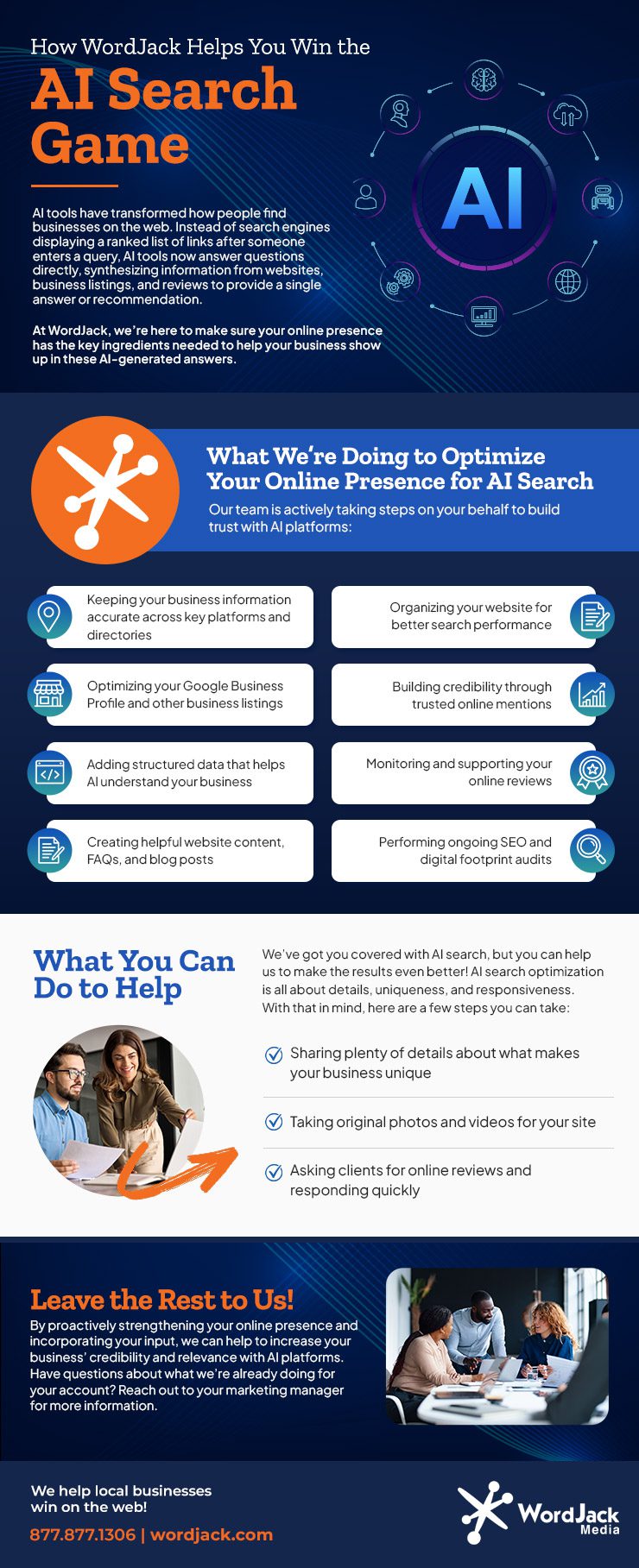
AI search isn’t something that happens to a business from the outside — it rewards the same accuracy, consistency, and genuine substance that’s always mattered online. We’re handling the heavy lifting on our end, and a bit of collaboration from yours is what turns good work into amazing results.
If you have questions about any of this, or want to know what’s already in motion for your account, your marketing manager is always the best place to start.
